Verified
My nose opened within minutes during a bad cold, and I slept better that night. I stopped after the second day because I had read that continued use could make the blockage return.
21 Oct 2026

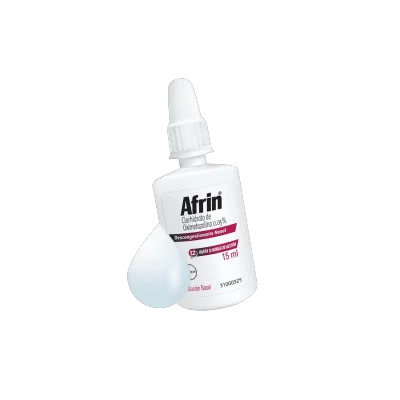
Afrin is a nasal decongestant for people with temporary blockage from colds, allergies, or sinus pressure. Its oxymetazoline ingredient narrows swollen blood vessels in the nasal lining, helping air pass more freely within minutes.
Afrin is a topical nasal decongestant containing oxymetazoline hydrochloride. It belongs to the sympathomimetic nasal decongestant class and is intended for short-term relief of blocked nasal breathing.
The active ingredient is oxymetazoline hydrochloride. The product is supplied as nasal drops in a 15 ml bottle.
Afrin is presented as nasal drops from a bottle rather than as an oral tablet. The liquid is placed into the nostrils, where oxymetazoline contacts the swollen nasal mucosa.
Use Afrin according to the product directions for the intended age group. General administration principles include:
The exact amount per application depends on the labelled formulation and age group. Children require special caution because accidental swallowing or excessive dosing can cause serious effects.
Oxymetazoline acts directly on blood vessels in the nasal lining rather than affecting congestion throughout the whole body. Oxymetazoline stimulates alpha-adrenergic receptors in those vessels, causing vasoconstriction. The reduced blood flow lowers tissue swelling and opens the nasal passages temporarily.
Afrin is intended for short-term relief of blocked nasal breathing. It may help congestion linked to a common cold, allergic irritation, or sinus pressure, although it does not remove the underlying virus, allergy trigger, or sinus disease.
The World Health Organization classifies oxymetazoline within the nasal decongestant group [1].
Different approaches suit different symptoms. Afrin acts locally and quickly, while oral decongestants circulate throughout the body. Saline products do not constrict blood vessels and therefore do not create the same rebound pattern.
| Option | Main action and limitation | Rebound or systemic concern |
|---|---|---|
| Afrin nasal drops | Local oxymetazoline vasoconstriction for rapid temporary relief | Rebound congestion with prolonged use; possible cardiovascular effects |
| Saline nasal solution | Moistens and washes the nasal passages without a vasoconstrictor | No medication-related rebound; relief may be less immediate |
| Oral pseudoephedrine or phenylephrine | Systemic decongestion through adrenergic stimulation | May affect blood pressure, pulse, sleep, or urinary symptoms |
Sodium chloride nasal preparations can help loosen mucus and reduce dryness. They are useful when congestion is mild, when repeated nasal moisture is needed, or when a person should avoid sympathomimetic medicines.
Pseudoephedrine may provide systemic relief but requires caution in hypertension, heart disease, glaucoma, thyroid disease, and urinary retention. Phenylephrine has a similar systemic route, with suitability depending on the formulation and the person’s medical history.
Afrin’s advantage is targeted action and rapid opening of the nasal passages. Its drawback is the narrow treatment window. Saline has a wider tolerability margin but may not provide the same immediate reduction in swelling.
People using medicines that raise blood pressure, stimulant medicines, tricyclic antidepressants, or other decongestants should avoid combining treatments without clinical direction.
Afrin is not for you if you have an allergy to oxymetazoline, uncontrolled high blood pressure, or a condition listed below without clinical advice. People with heart disease, abnormal heart rhythm, glaucoma, thyroid disease, diabetes, or difficulty passing urine should seek medical assessment before use. Pregnancy, breastfeeding, childhood use, and treatment with blood-pressure medicines, stimulants, tricyclic antidepressants, or other decongestants also require clinical direction.
Many people tolerate short courses of oxymetazoline well. Local symptoms are more common than body-wide effects because Afrin is placed in the nose.
Possible nasal effects include:
A brief stinging sensation may settle quickly. Persistent burning, repeated bleeding, or marked irritation indicates that continued use may worsen the nasal lining.
If oxymetazoline is absorbed in excessive amounts, possible effects include headache, dizziness, palpitations, raised blood pressure, nervousness, or tremor. These effects are more concerning in young children and after accidental swallowing.
Seek urgent medical help for severe drowsiness, breathing difficulty, fainting, chest pain, a very fast or irregular heartbeat, or suspected ingestion by a child.
Several usage patterns reduce benefit or increase harm:
One overlooked detail is the throat taste that can occur when the liquid drains backward. Keeping the head in a neutral position and breathing gently reduces this problem.
In clinical practice, physicians often describe oxymetazoline as a short-term tool rather than a daily nasal treatment. It can be useful when congestion prevents sleep or makes nasal breathing difficult, but the three-day limit should be planned before the first application.
Doctors also look for the cause of repeated blockage. Allergic rhinitis, chronic sinus inflammation, nasal polyps, structural narrowing, and medication-related dryness may all require different management. Repeated Afrin use can hide the original problem temporarily while maintaining the swelling cycle.
A practical prescribing conversation usually covers the person’s blood pressure, heart rhythm, current medicines, age, pregnancy status, and duration of symptoms. This is more useful than simply asking whether the nose feels blocked.
Your order will be securely packed and shipped within 24 hours. This is exactly what your package will look like (images of an actual item sent). It has the size and look of a regular private letter (24x11x0.7 cm) and its contents cannot be seen.
My nose opened within minutes during a bad cold, and I slept better that night. I stopped after the second day because I had read that continued use could make the blockage return.
The drops helped one nostril more than the other. I noticed a little burning for a few minutes, but it settled. The main difficulty was remembering not to keep using it once the cold started improving.
It worked at first, but the congestion came back quickly between applications. By the fifth day I felt dependent on it for sleep, so I needed a different plan for the blocked nose.
Breathing became easier soon after application. I also had mild dryness and avoided another dose when I developed a small nosebleed.