Verified
I took the tablets with breakfast and did not notice a dramatic change. My routine felt easy to maintain, but I still continued my prescribed blood-pressure medicine and measured my readings twice a week.
3 Oct 2026

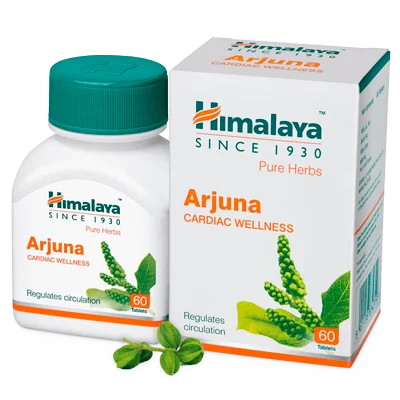
Arjuna is a botanical tablet for adults seeking traditional cardiovascular wellness support. Its bark-derived plant compounds are studied for antioxidant activity and possible support of circulation and heart function.
Arjuna refers to Terminalia arjuna, a large tree native to the Indian subcontinent and classified within the Combretaceae family. The tree commonly grows near riverbanks and other areas with access to moisture. Its thick, pale outer bark has been the traditional source of medicinal preparations.
The bark contains several plant compounds studied for antioxidant, vascular, and cardiac effects. Traditional Ayurvedic medicine has used Arjuna bark in preparations intended to support circulation and heart function for many generations.
The tablet form provides a more convenient alternative to preparing loose bark or a decoction. The product is presented as a herbal cardiac-wellness supplement in tablet form, with 60 tablets per box.
The principal research interest in Terminalia arjuna concerns triterpenoids, flavonoids, tannins, saponins, and other polyphenolic compounds found in the bark. Arjungenin, arjunic acid, and arjunolic acid are among the named triterpenoids investigated in laboratory and clinical research.
These compounds are studied for their possible effects on oxidative stress, inflammatory signalling, vascular tone, and myocardial function. Laboratory activity does not automatically prove that a tablet will treat a diagnosed cardiovascular disease. The strength of evidence varies by preparation, extraction method, and clinical context.
| Compound group | Research interest |
|---|---|
| Triterpenoids, including arjungenin and arjunolic acid | Antioxidant and cardioprotective activity |
| Flavonoids and polyphenols | Oxidative-stress and vascular research |
| Tannins and saponins | Traditional pharmacological investigation |
The exact concentration of individual compounds can vary between raw bark, extracts, and finished tablets. For that reason, findings from a concentrated extract should not be transferred automatically to every Arjuna preparation.
Practical administration points include:
A missed dose is generally handled by taking the next scheduled dose at the usual time rather than taking extra tablets. If several doses have been missed, resume the stated schedule rather than attempting to compensate.
The practical mistake is comparing a tablet with a spoonful of Arjuna bark powder. These forms are not interchangeable because their preparation and concentration may differ.
Arjungenin, arjunic acid, arjunolic acid, flavonoids, tannins, saponins, and other polyphenolic compounds from Terminalia arjuna are studied for antioxidant, vascular, inflammatory, and myocardial effects. These compounds may influence oxidative stress, inflammatory signalling, vascular tone, and cardiac function.
Arjuna has a traditional cardioprotective role, meaning it has been used to support the heart and circulation. Modern research has explored its possible influence on exercise tolerance, endothelial function, oxidative stress, and selected cardiovascular symptoms. A review of Terminalia arjuna describes traditional cardiotonic use alongside laboratory evidence involving antioxidant and vascular effects [1].
The product’s “cardiac wellness” positioning supports general cardiovascular care. It does not establish Arjuna as a treatment for heart disease, angina, or hypertension. Those conditions require diagnosis, monitoring, and treatment plans based on blood pressure, symptoms, electrocardiography, kidney function, and other clinical findings.
Potential areas of interest include:
Chest pressure, pain spreading to the arm or jaw, sudden breathlessness, fainting, or cold sweating require urgent medical assessment. Arjuna is not an appropriate response to possible acute coronary symptoms.
Research on Terminalia arjuna has included small human studies and traditional-use reviews, yet the evidence does not match the depth available for established cardiovascular medicines. The National Center for Complementary and Integrative Health also separates traditional use from evidence sufficient to replace conventional treatment [2].
Arjuna belongs to the herbal-support category. Prescription cardiovascular medicines are selected according to a diagnosed condition and measurable clinical targets.
| Approach | Main role |
|---|---|
| Arjuna herbal tablets | Traditional cardiovascular wellness and circulation support |
| Prescription antihypertensive therapy | Lowering blood pressure through a defined pharmacological pathway |
| Lifestyle cardiovascular care | Supporting blood pressure, glucose, lipids, fitness, and body weight |
Prescription therapy has stronger evidence for reducing cardiovascular events in specific conditions. Arjuna may appeal to adults seeking botanical support, but it should not be used as a substitute for treatment prescribed after a cardiovascular diagnosis.
A physician may consider whether Arjuna fits alongside existing therapy by reviewing blood pressure, pulse, symptoms, kidney function, and the full medication list. The answer can differ for someone taking no medication compared with someone using several agents for hypertension or heart disease.
Avoid it or obtain specific clinical direction before use in the following situations:
Possible interactions deserve attention. Arjuna may add to the blood-pressure-lowering effect of antihypertensives. Caution is also appropriate with medicines affecting heart rate, drugs used for heart failure, anticoagulants, antiplatelet medicines, and medicines with a narrow therapeutic range.
The evidence for each interaction is not equally strong, and the absence of a published interaction does not guarantee that a combination is suitable. A medication review is needed when Arjuna is combined with cardiovascular treatment.
NOT for you if: you are pregnant or breastfeeding, have unexplained fainting or very low blood pressure, or plan surgery without clinical guidance.
Arjuna is often tolerated without major problems in traditional use, yet side effects remain possible. Reported concerns include digestive discomfort, nausea, constipation or loose stools, headache, dizziness, and allergic reactions. The available evidence does not support a reliable frequency estimate for every tablet preparation.
Lower blood pressure can be helpful for someone with hypertension, but it can cause weakness or light-headedness when combined with blood-pressure medicines. A slower pulse may also be clinically relevant in a person using medicines that reduce heart rate.
Watch for:
A rash with facial swelling or breathing difficulty requires urgent care. Severe chest symptoms also require immediate assessment rather than another herbal dose.
One detail patients often miss is that a normal home blood-pressure reading does not prove that every cardiovascular risk has been controlled. Cholesterol, diabetes, smoking, kidney disease, and family history can remain relevant even when symptoms are absent.
Another practical point concerns surgery. Herbal products can become relevant to perioperative medication planning, especially when blood pressure, bleeding, or anaesthesia is involved. Tell the surgical team about Arjuna before a planned procedure.
Several routine errors can reduce the usefulness of Arjuna or create avoidable safety problems:
A common misconception is that natural products cannot affect blood pressure. Plant compounds can influence physiological systems, and the clinical effect may become more noticeable when several products act in the same direction.
In clinical practice, physicians usually place Arjuna in the complementary-care category rather than treating it as a replacement for evidence-based cardiovascular medicine. The useful question is whether the supplement can be used without disrupting blood-pressure control, heart-rate monitoring, or adherence to prescribed therapy.
A doctor would also distinguish wellness support from disease treatment. Someone with diagnosed angina needs an established plan for symptom prevention and urgent symptom management. Someone with hypertension needs repeated readings and treatment decisions based on cardiovascular risk, not on symptoms alone.
Consistency helps clinicians assess cause and effect. Starting several supplements at once makes it difficult to determine which product caused a benefit, dizziness, stomach symptoms, or a change in blood pressure.
The World Health Organization recognises the importance of quality, safety, and appropriate use when traditional medicines are integrated into health care [3]. That principle applies to herbal cardiovascular products as well as to other non-prescription preparations.
Arjuna is traditionally used for heart and circulation support, and Terminalia arjuna has been studied for antioxidant and cardioprotective effects. The evidence is more limited than the evidence for established cardiovascular medicines. A 2018 review in the Journal of Traditional and Complementary Medicine described traditional use and pharmacological research while also identifying the need for stronger clinical evidence . Evidence remains limited across preparations. Clinical outcomes vary.
Arjuna should not be treated as a stand-alone treatment for hypertension. Its possible blood-pressure effects may be relevant when it is combined with antihypertensive medicines, creating a risk of excessive lowering. MOHAP cardiovascular care guidance from 2024 focuses on diagnosis, repeated measurements, risk assessment, and appropriate treatment rather than relying on a supplement alone.
A combination may increase the blood-pressure-lowering effect, which can lead to dizziness, weakness, or fainting. The interaction evidence is not equally developed for every medicine or preparation. The 2017 EMA guidance on herbal medicinal products supports evaluating product-specific safety and interactions rather than assuming that traditional use confirms compatibility [4].
There is no dependable universal onset time for Arjuna tablets. Traditional preparations, extracts, and finished tablets can differ in composition, while clinical studies have used different schedules and outcome measures. WHO’s 1999 monograph framework for medicinal plants treats preparation quality and evidence assessment as central factors when interpreting herbal effects .
Use during pregnancy or breastfeeding should be avoided unless a qualified clinician who knows the full medical history specifically directs it. Safety data for many herbal cardiovascular preparations remain limited, and the FDA’s 2022 supplement guidance does not establish safety in these populations. The absence of a reported problem does not establish safety for fetal development or an infant.
Discuss Arjuna before planned surgery because herbal products can be relevant to blood pressure, heart rate, bleeding assessment, and anaesthesia planning. The surgical team may advise stopping it for a defined period based on the procedure and other medicines. The FDA’s 2022 advice asks patients to disclose all dietary supplements before medical procedures because supplement effects and interactions can influence perioperative care [5].
Your order will be securely packed and shipped within 24 hours. This is exactly what your package will look like (images of an actual item sent). It has the size and look of a regular private letter (24x11x0.7 cm) and its contents cannot be seen.
Arjuna preparations may be made from bark powder, dried bark decoctions, or more concentrated extracts. Tablet products offer consistent administration and avoid the preparation time associated with boiling loose bark.
The Arjuna product on this page is supplied as tablets. It is not a tea, loose Arjuna Bark Powder, or a 100 g powder format. Those preparation types may differ in concentration, taste, absorption, and dosing instructions.
A tablet can be easier to incorporate into a daily routine, yet the format does not remove the need to consider medicines, blood pressure, kidney function, or pregnancy. Herbal products can have physiological effects and may add to the action of prescription treatment.
I took the tablets with breakfast and did not notice a dramatic change. My routine felt easy to maintain, but I still continued my prescribed blood-pressure medicine and measured my readings twice a week.
The first few days caused mild stomach discomfort when I took the tablet without food. Taking it after breakfast was easier, and the symptoms settled.
I chose Arjuna for general cardiac wellness. I appreciated the tablet format, although I expected a clearer effect and decided not to increase the amount myself.
I felt light-headed after adding it to two blood-pressure medicines. The symptoms improved after the combination was reviewed, so I would not treat a herbal product as automatically free of interactions.