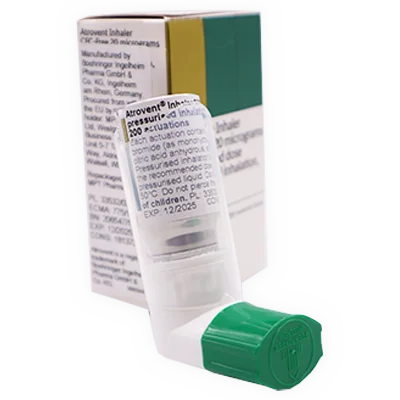
Description
Atrovent is a prescription inhalation medicine containing ipratropium bromide, a short-acting muscarinic antagonist. It is used mainly to relieve airflow limitation in chronic obstructive pulmonary disease and related bronchospasm. By blocking muscarinic receptors in the airways, it reduces narrowing and supports bronchodilation.
Composition
Atrovent pressurised inhalation contains ipratropium bromide at 20 micrograms per actuation. Ipratropium belongs to the short-acting muscarinic antagonist class, also called a short-acting anticholinergic bronchodilator. Its chemical structure is related to atropine, but inhaled ipratropium acts mainly within the respiratory tract and has limited passage into the central nervous system.
The medicine is delivered through an inhaler. Each actuation releases a measured amount into the airways when the device is used correctly. The formulation is intended for inhalation rather than swallowing.
Ipratropium blocks the effect of acetylcholine at muscarinic receptors in bronchial smooth muscle. This reduces vagally mediated airway constriction and allows the bronchial passages to remain more open. The World Health Organization lists ipratropium among medicines used in respiratory care, while national prescribing information defines its approved uses and administration requirements.
Rinse your mouth with water after inhalation if dryness or an unpleasant taste develops. Do not swallow the rinse if mouth irritation is a recurring problem.
Dosage and usage
The exact schedule should follow the prescribed regimen for this inhaler. Atrovent is inhaled through the mouth, and each actuation contains 20 micrograms of ipratropium bromide.
Typical administration involves these steps:
- Remove the protective cap and make sure the mouthpiece is clear.
- Breathe out gently, away from the inhaler.
- Seal your lips around the mouthpiece.
- Begin a slow, deep breath through the mouth while pressing the canister once.
- Continue inhaling steadily.
- Hold the breath briefly if comfortable, then breathe out slowly.
- Replace the cap after use.
The inhaler must be coordinated with the beginning of inhalation. Pressing too early can leave medicine in the mouth or on the tongue, while pressing too late can reduce the amount reaching the lower airways. A spacer may help people who have difficulty coordinating the canister and breath, when compatible with the prescribed device. A missed dose should be taken when remembered unless the next scheduled dose is near. Do not take extra actuations to compensate for a missed dose. Taking repeated doses beyond the prescribed plan may increase dry mouth, palpitations, blurred vision, urinary difficulty, and other anticholinergic effects.
The mouthpiece should be kept free of powder, mucus, and moisture. A blocked mouthpiece can change the spray pattern and make a normal inhalation feel unexpectedly weak.
One practical issue is that a pressurised inhaler can feel empty before the canister appears completely silent. Counting actuations from the first use gives a more reliable estimate than shaking the device, because liquid movement does not accurately show how much medicine remains.
Another common error is breathing in too quickly. A slow inhalation carries more of the aerosol into the lungs and leaves less medicine deposited in the mouth and throat. An inhaler technique review is useful when symptoms remain poorly controlled despite regular use.
How it works
Ipratropium bromide attaches to muscarinic receptors on airway smooth muscle and prevents acetylcholine from producing bronchoconstriction. The result is relaxation of the bronchial muscle, a wider airway lumen, and improved movement of air during breathing.
The drug has limited systemic absorption compared with an oral anticholinergic medicine. Its action remains concentrated in the respiratory tract, although some of the dose can reach the mouth, throat, eyes, or digestive system if inhalation technique is poor.
Atropine provides the pharmacological family connection. Atrovent is a quaternary ammonium antimuscarinic compound, which limits movement across the blood–brain barrier. This helps explain why central nervous system effects are less prominent than with some tertiary anticholinergic drugs, although local and systemic anticholinergic effects remain possible.
The 2023 Global Initiative for Chronic Obstructive Lung Disease strategy describes short-acting bronchodilators as useful for symptom relief and initial treatment decisions in COPD. The precise place of ipratropium depends on the person’s symptoms, lung function, other medicines, and treatment goals.
Atrovent works through a different receptor system from salbutamol. Salbutamol stimulates beta-2 receptors and relaxes airway muscle through adrenergic signalling. Using more than one bronchodilator class can produce additional bronchodilation, but combined treatment should follow a clinician’s dosing plan because adverse effects can also add together.
Indications
Atrovent is used for bronchodilation in obstructive airway disease. Its main clinical role is maintenance treatment for chronic obstructive pulmonary disease, including chronic bronchitis and emphysema. COPD causes persistent narrowing of the airways, excess mucus, or loss of elastic recoil, which can make breathing feel restricted.
The medicine reduces the cholinergic component of bronchoconstriction. It can improve airflow and reduce symptoms such as wheezing, chest tightness, and breathlessness when these symptoms are related to reversible airway narrowing.
Atrovent is not a corticosteroid. It does not reduce airway inflammation in the same way as an inhaled corticosteroid. It is also not a long-acting bronchodilator. A prescriber may include it in a wider respiratory treatment plan alongside other inhaled medicines, depending on lung function, symptom pattern, exacerbation history, and diagnosis.
Clinical benefit may be more noticeable when airway narrowing is driven by parasympathetic nerve activity. Patients with COPD often use it at regular intervals rather than waiting for severe breathlessness. Sudden worsening breathlessness, blue lips, confusion, chest pain, or inability to speak in full sentences requires urgent medical attention.
Comparison
Atrovent, tiotropium, and salbutamol differ in receptor activity and duration. They are not interchangeable solely because all three can widen the airways.
Tiotropium is designed for longer maintenance coverage and is commonly used as part of persistent COPD management. Atrovent has a shorter duration and may be selected when a short-acting anticholinergic option is appropriate.
Salbutamol acts through beta-2 receptors and is widely used for rapid relief of bronchospasm. It may produce tremor, nervousness, or a fast heartbeat. Atrovent tends to produce anticholinergic effects such as dry mouth, though palpitations can also occur.
The preferred option depends on diagnosis and treatment plan. A person with COPD may need scheduled long-acting therapy, short-acting relief, or a combination of bronchodilator classes. A person with asthma may require anti-inflammatory treatment because bronchodilation alone does not address airway inflammation.
Contraindications
- Previous serious hypersensitivity to ipratropium, atropine, belladonna alkaloids, or any formulation component
- Narrow-angle glaucoma or raised intraocular pressure
- Benign prostatic hyperplasia with difficulty passing urine
- A history of urinary retention
- Severe bladder outflow obstruction
- Cystic fibrosis with a tendency toward gastrointestinal motility problems
- Pregnancy or breastfeeding when the expected benefit and possible risk need individual assessment
Atrovent can interact pharmacodynamically with other anticholinergic drugs. Examples include some medicines used for overactive bladder, certain antihistamines, tricyclic antidepressants, and other inhaled anticholinergics. The combined effect may increase dry mouth, constipation, blurred vision, fast heartbeat, or urinary difficulty.
When this is not for you
Atrovent may not be suitable if you have had a serious reaction to ipratropium, atropine, belladonna alkaloids, or an ingredient in the inhaler. Tell your clinician if you have narrow-angle glaucoma, eye-pressure problems, difficulty urinating, urinary retention, bladder outflow obstruction, cystic fibrosis with gastrointestinal motility problems, or if you are pregnant or breastfeeding. Extra caution is needed if you use bladder medicines, certain antihistamines, tricyclic antidepressants, or other anticholinergic inhalers, because side effects can add together.
Side effects
Atrovent is often tolerated without major problems, but local anticholinergic effects can occur. Commonly reported effects include:
- Dry mouth or throat
- Throat irritation
- Cough after inhalation
- Headache
- An unpleasant taste
- Nausea or mild digestive discomfort
- Dizziness
- Blurred vision if the aerosol reaches the eyes
Dry mouth may improve with regular sips of water, sugar-free gum, or sugar-free lozenges. Persistent mouth soreness, difficulty swallowing, or dental problems require clinical review because reduced saliva can affect oral comfort and dental health.
Blurred vision is more likely when the spray enters the eyes. This can happen when the inhaler is held too close to the eyes, when a face mask leaks, or when the patient sprays without sealing the mouthpiece properly. Eye pain, halos around lights, severe redness, or a sudden reduction in vision require urgent assessment because anticholinergic exposure can raise intraocular pressure in susceptible people.
Throat irritation often reflects deposition in the upper airway rather than a serious allergy. Slow inhalation and correct mouthpiece positioning can reduce this problem. A spacer may also reduce mouth and throat deposition where the device and prescription allow one.
Remove contact lenses before using the inhaler if the spray may reach your eyes. This is a small step, but it avoids confusion between lens discomfort and an eye reaction.
The 2022 FDA prescribing information describes dry mouth, headache, respiratory irritation, and eye-related effects among recognised adverse reactions to inhaled ipratropium. The frequency and severity can vary with dose, technique, age, coexisting disease, and concurrent anticholinergic medicines.
Common mistakes
Several practical mistakes reduce the benefit of Atrovent:
- Treating it as a substitute for every other prescribed inhaler
- Taking extra actuations because breathlessness has not improved quickly
- Spraying toward the eyes or using a leaking face mask
- Inhaling too fast or failing to coordinate pressing and breathing
- Stopping regular maintenance doses after a few comfortable days
- Forgetting to report urinary hesitancy or eye pain
- Sharing an inhaler with another person
- Assuming that a familiar inhaler technique remains correct without periodic review
One missed dose does not justify doubling the next dose. Repeated extra use can intensify anticholinergic adverse effects without addressing the cause of worsening breathlessness.
A common misconception is that dry mouth proves the medicine is reaching the lungs. It does not. Dryness may result from deposition in the mouth, while poor inhalation coordination may still leave too little drug in the lower airways.
What doctors say
In clinical practice, doctors usually judge Atrovent by symptom relief, exercise tolerance, night-time breathing, rescue inhaler use, and exacerbation frequency. Improvement is not measured only by how the throat feels immediately after one inhalation.
A respiratory clinician would also check inhaler technique before assuming that the medicine has failed. A patient may press the canister too early, inhale too rapidly, fail to breathe in deeply, or stop inhaling as soon as the spray is released. Each error can reduce lung delivery without changing the prescribed dose.
The main advantages are local bronchodilator action, a well-established antimuscarinic mechanism, and usefulness in COPD-related airflow limitation. Limitations include a shorter duration than tiotropium, possible dry mouth, and the need for careful eye protection in people at risk of glaucoma. Not for you if a clinician has advised against anticholinergic inhalers because of serious hypersensitivity, uncontrolled eye pressure, urinary retention, or another relevant risk.
Doctors may reassess the treatment when symptoms remain frequent, exercise capacity declines, sputum changes, or the need for additional rescue treatment increases. A change in symptoms can signal disease progression or infection rather than simple underdosing.