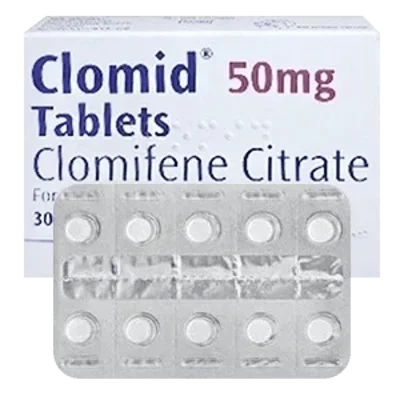
Description
Clomid is an oral tablet containing clomifene citrate, a selective estrogen receptor modulator used to induce ovulation. It is prescribed mainly for women with anovulatory infertility, including infertility associated with polycystic ovary syndrome. By reducing estrogen feedback to the hypothalamus, Clomid increases pituitary release of FSH and LH, helping a developing follicle mature and release an egg.
Composition
Active Ingredient Composition
The dose is stated on the pack — follow the leaflet. The active substance is a non-steroidal SERM with activity at estrogen receptors involved in hypothalamic feedback.
The therapeutic aim is not to supply estrogen. It is to modify estrogen feedback temporarily so the reproductive hormone system increases FSH and LH secretion.
The US Food and Drug Administration prescribing information describes its use for ovulatory dysfunction in women wishing to become pregnant [1].
Dosage and usage
The dose is stated on the pack — follow the leaflet.
A typical cycle may follow this pattern:
- Pregnancy is excluded before treatment.
- The clinician identifies the appropriate cycle day.
- The dose stated on the pack is taken according to the leaflet.
- Ovulation is assessed through symptoms, urine testing, blood testing, or ultrasound.
- A later course is considered only after the response and safety findings are reviewed.
Some treatment protocols begin around cycle day 2, 3, 4, or 5. The appropriate start depends on the menstrual pattern and the clinician’s fertility strategy. A higher daily dose may be considered after a non-ovulatory course, but dose escalation should not be self-directed.
Treatment duration is limited because repeated exposure can increase cumulative concerns, including visual symptoms and ovarian complications. The FDA prescribing information describes stepwise dose adjustment and limits prolonged treatment when ovulation does not occur .
If a dose is missed, do not double the next dose. Contact the fertility clinic promptly because the missed tablet may affect the planned sequence and the timing of ovulation monitoring.
Clomid may be taken with or without food. Taking it at the same time each day can make the treatment schedule easier to follow. Nausea or flushing may feel more noticeable at certain times, so some patients prefer an evening dose when their clinician permits that timing.
How it works
A SERM binds to estrogen receptors and produces different effects in different tissues. In the hypothalamus, clomifene reduces the perceived estrogen signal. The brain responds by increasing gonadotropin-releasing hormone activity, which encourages the pituitary gland to release follicle-stimulating hormone and luteinizing hormone.
Clomid influences the hypothalamic–pituitary–ovarian axis. This system links brain hormone signals with ovarian follicle development and ovulation. Its activity changes across the menstrual cycle. The hypothalamus, pituitary gland, and ovaries communicate through coordinated hormone signals.
FSH supports growth of ovarian follicles. LH contributes to follicular maturation and triggers ovulation after the dominant follicle has developed. When clomifene blocks estrogen feedback at the hypothalamus, the pituitary receives a weaker signal that estrogen activity is sufficient. FSH and LH secretion may then rise, supporting follicle recruitment and ovulation.
Indications
Clomifene citrate is used for anovulatory infertility, meaning the ovaries do not release an egg regularly. Polycystic ovary syndrome is a common cause of irregular or absent ovulation, although the medicine is not suitable for every person with PCOS.
Patients may be considered for Clomid when:
- Ovulation is absent or unpredictable.
- Pregnancy is desired.
- The ovaries have sufficient functional reserve.
- Pregnancy has been excluded before treatment begins.
- Other causes of infertility have been assessed.
- The treatment plan includes monitoring for ovarian response.
Clinical fertility assessment may include menstrual history, ovulation testing, pelvic ultrasound, thyroid evaluation, prolactin measurement, ovarian reserve testing, and semen analysis when relevant. Clomid cannot correct blocked fallopian tubes, severe male-factor infertility, or infertility caused by conditions that require another treatment.
The World Health Organization identifies ovulatory disorders as an important category of infertility requiring targeted diagnosis and treatment. Its infertility guidance published in 2023 supports an individualised approach rather than treating every irregular menstrual cycle with the same medicine [2].
A fertility clinician often explains the goal in practical terms: produce one mature follicle and predictable ovulation, not simply raise hormone levels. Excessive ovarian response can increase the chance of multiple pregnancy and requires clinical supervision.
Comparison
Clomid and generic clomiphene citrate contain the same active pharmaceutical substance when the strength and formulation are equivalent. The clinical difference usually relates to treatment planning, excipients, tablet supply, and the patient’s monitored response rather than a different ovulation mechanism.
Enclomifene and zuclomifene are stereoisomers associated with clomifene citrate. Clomifene citrate contains a mixture of isomeric forms with different persistence and estrogen-receptor activity. Enclomifene has been studied as a separate hormonal compound, but it should not be treated as interchangeable with the tablets supplied for Clomid treatment.
Letrozole may be selected for some patients with PCOS, while injectable gonadotropins may be considered when oral induction is unsuccessful or when assisted reproductive treatment is planned. The choice depends on age, ovarian reserve, ovulation history, body weight, semen analysis, tubal findings, and previous treatment response.
Contraindications
Clomid is not suitable in several situations. A fertility clinician should establish the cause of infertility and exclude pregnancy before treatment begins.
- Known or suspected pregnancy.
- Liver disease or a history of significant liver dysfunction.
- Undiagnosed abnormal uterine bleeding.
- An ovarian cyst unrelated to PCOS.
- Uncontrolled thyroid or adrenal disease.
- Ovarian failure that cannot respond to stimulation.
- A known allergy to clomifene citrate or an excipient in the tablet.
- Active visual symptoms associated with previous clomifene treatment.
When this is not for you
Clomid is not for you if you have:
- Known or suspected pregnancy.
- Liver disease or a history of significant liver dysfunction.
- Undiagnosed abnormal uterine bleeding.
- An ovarian cyst unrelated to PCOS.
- Uncontrolled thyroid or adrenal disease.
- Ovarian failure that cannot respond to stimulation.
- A known allergy to clomifene citrate or an excipient in the tablet.
- Active visual symptoms associated with previous clomifene treatment.
Treatment should also be reconsidered when pelvic pain, enlarged ovaries, severe endometriosis, or a high risk of ovarian hyperstimulation is present. Clomid does not treat the underlying cause of every infertility pattern.
Side effects
The most common effects are linked to hormonal stimulation and estrogen-receptor modulation. Patients may experience hot flushes, headache, breast discomfort, nausea, mood changes, abdominal discomfort, or bloating.
Visual symptoms deserve special attention. Blurred vision, flashing lights, spots, or difficulty focusing can occur and may persist after treatment. Clomid should be stopped and urgent medical advice obtained if visual symptoms develop, because continuing treatment after these symptoms may increase the risk of prolonged visual disturbance.
Other clinically significant risks include:
- Ovarian enlargement or ovarian cyst formation.
- Pelvic or abdominal pain.
- Ovarian hyperstimulation syndrome, which may cause marked bloating, vomiting, shortness of breath, or rapid weight gain.
- Multiple pregnancy, most often twins.
- Ectopic pregnancy when fertility treatment results in conception.
- Liver-related complications in susceptible patients.
- Mood changes that become severe or interfere with daily functioning.
The response can be emotionally demanding. A patient may ovulate successfully yet not conceive in that cycle. Clomid improves the chance of ovulation; it does not guarantee fertilisation or pregnancy.
Sudden abdominal swelling, severe pelvic pain, breathing difficulty, faintness, or rapid weight gain after a course needs urgent assessment because these symptoms can signal a significant ovarian response.
Some patients report that hot flushes are easier to manage with light clothing, cool fluids, and avoidance of overheated rooms. A new headache may be mild, but a severe headache accompanied by visual changes requires prompt medical review rather than another dose.
Common mistakes
Several errors can reduce the value of an otherwise appropriate treatment plan:
- Starting the five-day course on the wrong cycle day.
- Taking two tablets after a missed dose.
- Increasing the daily amount without a monitored response.
- Continuing despite flashing lights or blurred vision.
- Assuming a withdrawal bleed confirms ovulation.
- Skipping follow-up ultrasound when monitoring has been arranged.
- Ignoring severe abdominal pain or rapid abdominal enlargement.
- Taking ovulation-induction medicines while pregnancy has not been excluded.
- Treating Clomid as a general fertility enhancer when ovulation is already regular.
- Continuing repeated cycles without reviewing the diagnosis and treatment goals.
A common misconception is that a stronger dose always produces a better chance of pregnancy. More ovarian stimulation can raise the risk of multiple follicles, ovarian enlargement, and multiple pregnancy without producing a proportional benefit.
Keep a simple record of the first day of bleeding, each tablet day, ovulation-test results, and new symptoms. This gives the fertility clinician usable information when adjusting the next cycle.
What doctors say
In clinical practice, the most useful measure is ovulation confirmed through an appropriate monitoring plan, not a change in menstrual symptoms alone. Regular bleeding does not always prove that an egg was released.
Doctors also assess whether the uterine lining and cervical mucus remain favourable. Clomifene’s anti-estrogen effects may help ovulation while producing less favourable conditions for conception in some treatment cycles.
The European Medicines Agency guidance on medicines used for female infertility emphasises careful patient selection, cycle monitoring, and attention to ovarian response. A clinician will usually review the number and size of follicles before advising intercourse timing, intrauterine insemination, or a further treatment cycle [3].
One practical issue is timing. Ovulation may occur several days after the final tablet, so relying on a single calendar date can lead to missed fertile days. The fertility team may recommend urine LH testing, ultrasound, or a timed trigger depending on the protocol.