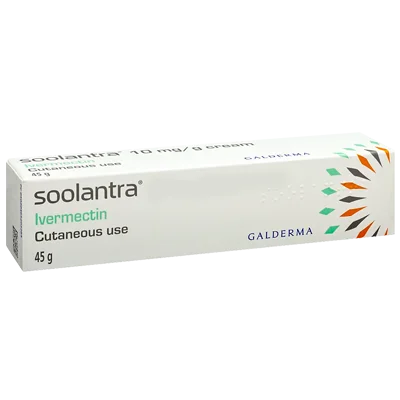
Description
Soolantra is a prescription topical cream containing ivermectin as its active pharmaceutical ingredient. The dose is stated on the pack — follow the leaflet. It belongs to the topical antiparasitic and anti-inflammatory treatments used in dermatology.
Composition
Soolantra is a dermatological cream built around a single active substance: ivermectin. The dose is stated on the pack — follow the leaflet. It comes in a 45 g tube, intended for once-daily facial application according to the leaflet. The cream is manufactured by Galderma, a company with a long track record in medical dermatology.
Ivermectin itself is not new to medicine. It has been used orally for decades to treat parasitic infections [1]. What Soolantra does differently is deliver it directly into the skin at a low, steady concentration, aimed specifically at the inflammatory component of rosacea rather than at a systemic parasite.
Active Ingredient and Formulation Characteristics
The cream vehicle matters more than it might seem. Facial skin affected by rosacea is often reactive, easily irritated by alcohol-based or heavily fragranced products. Soolantra's base is formulated to spread thinly and absorb without leaving a greasy residue, which matters for patient adherence — nobody sticks with a daily treatment that feels unpleasant under makeup or sunscreen.
Apply Soolantra as the last step in your routine, after moisturizer but before sunscreen. Layering it under thick creams can dilute contact with the skin and reduce effectiveness.
One detail patients often miss: the tube's narrow nozzle is designed to dispense a controlled amount. Squeezing too hard gives you more product than the pea-sized dose actually needed for the whole face.
Dosage and usage
Soolantra is applied once daily, in the evening or morning, as part of a fixed routine rather than an as-needed treatment.
- Wash the face with a gentle, non-abrasive cleanser and pat dry.
- Dispense a pea-sized amount of cream — roughly the size of a small pea per application, regardless of face size.
- Apply a thin layer to the entire face, covering each of the five typical zones: forehead, chin, nose, and both cheeks.
- Avoid the eyes, eyelids, lips, and the inside of the nose and mouth.
- Wash hands immediately after application.
If a dose is missed, apply it as soon as remembered that same day. Doubling up the next day to compensate does not speed up results and raises the chance of local irritation.
Don't apply Soolantra to broken or sunburned skin. Wait until the skin barrier has recovered, otherwise irritation risk goes up without any gain in effectiveness.
Keep the tube at room temperature and replace the cap immediately after use to prevent contamination and preserve the cream's texture.
A mistake seen often in practice: patients apply the cream only to visible red spots instead of the whole face. Rosacea involves a field of skin, not isolated lesions, so spot-treating leaves untreated Demodex mites and inflammatory signaling active in the surrounding tissue.
How it works
Ivermectin in Soolantra works through two separate but connected pathways. First, it has a direct anti-inflammatory effect, dampening the activity of pro-inflammatory cytokines that drive the redness, papules, and pustules typical of rosacea. Second, it has antiparasitic activity against Demodex folliculorum, a skin mite present in higher densities on rosacea-affected skin than on healthy skin [2].
Researchers have not settled on a single cause of rosacea. Current understanding treats it as the product of innate immune dysregulation, vascular changes, and a disproportionate Demodex load, acting together rather than in isolation. Soolantra does not chase one of these mechanisms alone. By calming inflammatory signaling while reducing mite density, it addresses two of the three recognized contributors at once.
Indications
Soolantra is indicated for the treatment of inflammatory lesions associated with rosacea in adult patients.
Comparison
This dual action sets it apart from antibiotic-based rosacea treatments, which work almost exclusively through anti-inflammatory and antimicrobial routes without addressing Demodex. A 2025 review in the Journal of Clinical and Aesthetic Dermatology noted that ivermectin's mite-reducing action may explain its durability of response compared with antibiotic creams, where relapse after stopping treatment is common [3].
Contraindications
Known hypersensitivity to ivermectin or any excipient in the formulation.
It should not be applied to open wounds, severely sunburned skin, or areas with active eczema flares, since broken skin barriers absorb more active ingredient than intact skin and raise the risk of systemic exposure.
Soolantra has not been studied for safety during pregnancy and breastfeeding in large controlled trials, and MOHAP guidance for topical ivermectin products recommends medical consultation before use in these situations.
When this is not for you
This medication is not for you if you have a known allergy to ivermectin or another ingredient in the cream. Ask a physician before using it during pregnancy or breastfeeding, and do not apply it to open wounds, severe sunburn, or active eczema.
Side effects
Clinical trial data submitted to regulatory bodies show that Soolantra is generally well tolerated, with most adverse events being mild and localized to the application site [4].
- Skin burning sensation — the most frequently reported effect, usually transient
- Skin irritation and dryness
- Pruritus (itching)
- Mild erythema beyond the baseline rosacea redness
These effects tend to appear in the first one to two weeks and often fade as the skin adjusts. Hypersensitivity reactions, including contact dermatitis, occur rarely but warrant stopping treatment and seeking medical advice if swelling, blistering, or significant worsening develops.
One nuance that's easy to overlook: a temporary increase in redness during the first weeks does not automatically mean the treatment is failing. In clinical practice, this initial flush is sometimes mistaken for a worsening of rosacea itself, when it is actually a short-lived reaction to the active ingredient settling into the skin.
What doctors say
Dermatologists who prescribe Soolantra regularly describe a fairly consistent pattern: slow but steady improvement rather than a dramatic early response. Patients who expect overnight clearing are often disappointed in week one and need reassurance to stay consistent through the full 12-week evaluation window typically used in clinical practice.
Honestly, the biggest predictor of success isn't the cream itself — it's whether the patient keeps applying it daily without skipping. Physicians often note that inconsistent use is the single most common reason for a perceived lack of response, more so than any issue with the drug's pharmacology.