Description
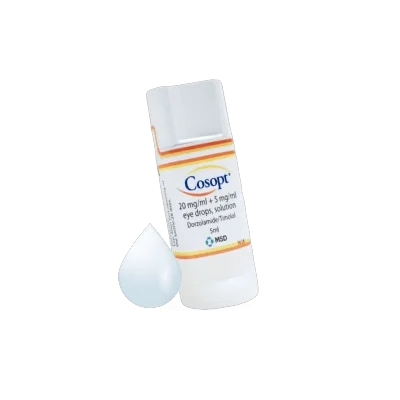
Cosopt is a sterile eye-drop solution supplied in a bottle containing 5 ml. Its active ingredients are dorzolamide hydrochloride and timolol maleate. The combination is used to lower intraocular pressure in adults with open-angle glaucoma or ocular hypertension. The dose is stated on the pack — follow the leaflet.
Composition
Cosopt is a sterile eye-drop solution supplied in a bottle containing 5 ml. Its active ingredients are dorzolamide hydrochloride and timolol maleate. The dose is stated on the pack — follow the leaflet.
Dosage and usage
The standard adult dose is one drop of Cosopt in the affected eye or eyes twice daily, approximately 12 hours apart. The exact treatment plan depends on the ophthalmologist’s pressure target and whether other eye medicines are also prescribed.
- Wash and dry the hands before use.
- Remove contact lenses before applying the drops.
- Avoid touching the dropper tip to the eye, eyelids, eyelashes, or fingers.
- Instil one drop into the lower conjunctival sac.
- Close the eye gently instead of blinking repeatedly.
- Apply nasolacrimal occlusion for about two minutes.
- Wait at least 10 minutes before using another eye drop.
- Replace contact lenses after at least 15 minutes, unless the prescriber gives different instructions.
- If a dose is missed, apply it when remembered unless the next dose is near; do not use two drops to compensate.
The bottle is intended for ophthalmic use only. Do not swallow the solution or apply it to the skin.
A useful routine is to link the morning dose with toothbrushing and the evening dose with another regular activity. Avoid squeezing the bottle while the tip is close to the eye, because a sudden extra drop can make dosing less precise.
How it works
Dorzolamide inhibits carbonic anhydrase in the ciliary processes, reducing bicarbonate formation and aqueous humour production. Timolol blocks beta-adrenergic receptors in the ciliary body, reducing aqueous humour secretion. Through these separate pathways, the combination lowers intraocular pressure.
Indications
Conditions Treated by Cosopt
Open-angle glaucoma usually progresses slowly. Many patients have no pain or obvious visual change during the early stages, so pressure checks and optic-nerve assessment remain central to treatment. Ocular hypertension means that intraocular pressure is above the usual range without established glaucomatous damage; treatment decisions depend on pressure level, optic-nerve appearance, corneal thickness, age, and other risk factors.
The Ocular Hypertension Treatment Study showed that lowering pressure can reduce the risk of developing glaucomatous damage in selected higher-risk patients [1]. Cosopt does not restore optic-nerve tissue already lost. Its role is pressure control and protection against further damage.
Comparison
Cosopt offers two mechanisms in one bottle. Clinicians may choose it when pressure remains above target with a single agent, when separate medicines create a complicated routine, or when a fixed combination improves adherence.
Prostaglandin analogues often provide strong pressure reduction with once-daily dosing, though eyelash growth, iris pigmentation, conjunctival redness, and periocular skin changes can occur. Beta-blocker monotherapy avoids adding a second topical mechanism but may be insufficient when pressure remains elevated.
A fixed combination can reduce the number of separate bottles and may improve adherence compared with multiple independent dosing schedules. The trade-off is that the patient receives timolol even when beta-blockade becomes unsuitable because of asthma, slow pulse, or conduction disease. Guidance from the European Glaucoma Society supports choosing treatment according to pressure target, disease severity, tolerability, and systemic health rather than using one regimen for every patient [2].
Contraindications
Cosopt is contraindicated or requires avoidance in people with:
- Bronchial asthma or a history of asthma.
- Severe chronic obstructive pulmonary disease.
- Sinus bradycardia.
- Second- or third-degree atrioventricular block without a functioning pacemaker.
- Overt cardiac failure or cardiogenic shock.
- Severe hypersensitivity to dorzolamide, timolol, or related ingredients.
- Severe renal impairment or hyperchloraemic acidosis, where dorzolamide may be unsuitable.
Timolol can worsen bronchospasm and slow cardiac conduction. Dorzolamide is a sulfonamide derivative, so a history of serious sulfonamide hypersensitivity requires careful evaluation.
Interactions also matter. Oral beta-blockers, calcium-channel blockers, antiarrhythmics, digitalis, clonidine, and medicines that lower blood pressure may increase cardiovascular effects. Other carbonic anhydrase inhibitors can increase the risk of additive systemic effects. Antidepressants that inhibit monoamine oxidase and medicines affecting catecholamine handling may also require review.
Tell the prescriber about insulin or other glucose-lowering treatment. Beta-blockers can mask some warning signs of low blood glucose, such as a rapid heartbeat.
When this is not for you
Cosopt is not suitable for everyone. NOT for you if you have asthma, a very slow pulse, or certain heart-conduction problems unless a clinician specifically advises otherwise. The prescriber needs a complete history of respiratory disease, heart rhythm problems, circulation disorders, kidney disease, liver disease, allergies, and current medicines.
Contact lenses require removal before dosing because some formulations may contain preservatives that can be absorbed by soft lenses.
Side effects
Local reactions are the most familiar effects of Cosopt. Burning, stinging, itching, tearing, blurred vision, a foreign-body sensation, or redness may occur shortly after application. Blurred vision should settle before driving or operating machinery.
Systemic effects can arise because dorzolamide and timolol may enter the circulation through the eye and nasal passages. Possible effects include:
- Dry or irritated eyes.
- Bitter taste after instillation.
- Headache or dizziness.
- Fatigue or reduced exercise tolerance.
- Slow pulse or low blood pressure.
- Shortness of breath or wheezing.
- Nausea or stomach discomfort.
- Sleep disturbance or unusual dreams.
- Depressed mood in susceptible patients.
Seek urgent medical attention for fainting, severe breathing difficulty, marked wheezing, chest pain, a very slow heartbeat, facial swelling, or sudden vision changes. These symptoms may indicate a serious cardiovascular, respiratory, allergic, or ocular reaction.
If the eye becomes very painful, intensely red, light-sensitive, or suddenly less able to see, do not treat the symptom by adding extra drops. These features need prompt ophthalmic assessment.
Common mistakes
Several routine errors can reduce treatment quality:
- Using two drops because the first drop was not felt.
- Instilling the bottle tip directly onto the eye.
- Skipping doses when vision feels normal.
- Applying different eye drops one immediately after another.
- Replacing contact lenses straight after dosing.
- Forgetting to mention asthma, slow pulse, or heart medicines.
- Stopping treatment abruptly without a replacement plan.
- Using a bottle that has become contaminated at the tip.
- Driving before temporary post-dose blurring has cleared.
One drop is generally enough to fill the conjunctival sac. A second drop mostly spills onto the cheek or drains through the nose, increasing waste and potentially increasing systemic absorption.
If the bottle tip touches the eye, eyelid, or eyelashes, keep using the prescribed schedule but report the contamination event to the dispensing pharmacy or prescriber for product-specific advice.
What doctors say
In clinical practice, doctors often view Cosopt as a useful step when one pressure-lowering drop has not reached the target. The fixed combination avoids asking a patient to remember two separate bottles with different schedules, which can be valuable for older adults or people using several medicines.
An ophthalmologist will usually judge success by measured pressure, optic-nerve findings, visual-field stability, and tolerance. Feeling no difference does not prove that the treatment is unnecessary. Glaucoma can remain symptom-free while damage continues.
The main limitation is timolol exposure. A patient with asthma, wheezing, a slow pulse, or heart block may need a different treatment strategy. Prescribers also consider kidney function because dorzolamide has a systemic elimination pathway.