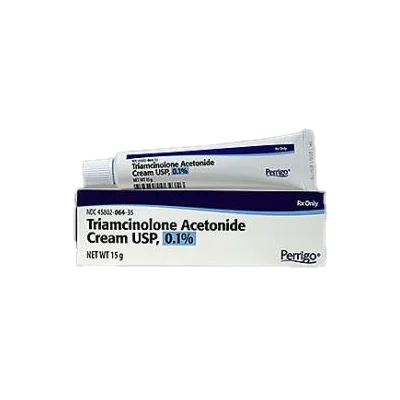
The itching on my hands eased within several days, and the redness faded gradually. I used a very thin layer at night and moisturised separately. The cream felt slightly irritating on the first application but that sensation did not continue.
Triamcinolone
Triamcinolone is a topical corticosteroid cream for people with inflammatory, itchy skin conditions. It helps calm excessive inflammatory activity in the skin, reducing redness, swelling, and itching.
Description
Triamcinolone is a topical corticosteroid cream containing triamcinolone acetonide 0.1%. It belongs to the corticosteroid class, also called glucocorticoids.
Composition
Triamcinolone contains triamcinolone acetonide at a concentration of 0.1% in a topical cream base. It belongs to the corticosteroid class, also called glucocorticoids. Applied to the skin, it acts locally on inflammatory cells and chemical mediators that contribute to itching, redness, swelling, and irritation.
The product is supplied as a topical cream in a 15 g presentation. Its intended route is application to the skin. It is not an oral tablet, injection, nasal spray, or eye preparation.
Triamcinolone cream may be prescribed for inflammatory dermatoses such as eczema, dermatitis, and selected allergic or irritant skin reactions. The exact diagnosis matters because corticosteroids can worsen some untreated infections or mask their progression.
The cream is a single-agent corticosteroid formulation. Combination creams may contain additional antibacterial or antifungal ingredients, but those components are not part of this product’s stated composition and should not be assumed to be present.
Local Skin Delivery
Topical administration places the active ingredient directly at the site of inflammation. Some absorption through the skin occurs, and absorption rises when the skin barrier is damaged, when large areas are treated, when the cream is used for a long period, or when the area is covered with an occlusive dressing.
The face, groin, armpits, and skin folds absorb topical corticosteroids more readily than thicker skin on the palms or soles. These areas require shorter treatment courses and careful clinical direction.
Dosage and usage
Use Triamcinolone as a thin film on the affected area, following the prescribed frequency and treatment duration. Rub it in gently until absorbed. Wash the hands after application unless the hands are the treatment site.
Do not place the cream inside the eyes, mouth, nose, vagina, or other mucous membranes. Avoid applying it to open wounds unless a clinician has specifically directed this use. Keep the cream away from the eyelids because repeated corticosteroid exposure around the eyes may contribute to glaucoma or cataract formation.
Treatment principles include:
- Use a thin layer rather than a thick coating.
- Apply only to affected areas.
- Avoid airtight coverings unless specifically prescribed.
- Do not use it for acne, rosacea, or facial flushing without a suitable diagnosis.
- Do not share the tube with another person.
- Wash hands before and after application when the hands are not being treated.
- If an application is missed, apply it when remembered unless the next scheduled application is near; do not apply a double layer.
The fingertip-unit method can help estimate topical quantity. One adult fingertip unit is the amount expressed from the tip of an adult finger to its first crease, and it covers roughly two adult palm areas. The amount needed varies with the body site and the size of the rash.
Cream is often comfortable for moist or weeping areas because it is less greasy than an ointment. It may feel less suitable on very dry, cracked skin, where a prescriber may select another vehicle. The vehicle does not change the need for correct diagnosis.
How it works
Triamcinolone acetonide is a topical glucocorticoid that acts locally on inflammatory cells and chemical mediators in the skin. By suppressing excessive inflammatory activity, it reduces the processes that contribute to itching, redness, swelling, and irritation.
Indications
Triamcinolone cream is used to reduce inflammatory skin symptoms, including:
- Redness and irritation
- Itching caused by inflammatory dermatitis
- Local swelling
- Dry, scaly, or thickened patches associated with eczema
- Certain allergic or irritant contact reactions
- Other corticosteroid-responsive dermatoses diagnosed by a clinician
The cream treats inflammation rather than the underlying trigger in every skin condition. For example, removing an irritant remains necessary in contact dermatitis, while a confirmed fungal infection requires appropriate antifungal treatment rather than corticosteroid treatment alone.
Clinical practice usually favours the lowest-strength corticosteroid that controls symptoms for the shortest suitable period. Triamcinolone 0.1% is stronger than mild hydrocortisone preparations, so treatment should be matched to the affected body site, diagnosis, patient age, and severity of inflammation. The FDA prescribing information describes triamcinolone acetonide cream as a topical corticosteroid for corticosteroid-responsive dermatoses.
A useful distinction is symptom control versus cure. Itching may settle before the skin barrier has fully recovered, and stopping too early can allow inflammation to return. Continuing indefinitely creates a different problem because prolonged corticosteroid exposure can thin the skin.
Comparison
Comparison by Treatment Category
| Treatment approach | Main role | Key limitation |
|---|---|---|
| Triamcinolone 0.1% cream | Reduces local inflammatory skin activity | Prolonged or excessive use may thin skin |
| Mild topical corticosteroid | Suitable for sensitive sites or mild inflammation | May not control thicker or more severe plaques |
| Topical antifungal or antibacterial treatment | Targets selected infections | Does not replace corticosteroid treatment for non-infectious inflammation |
Triamcinolone is chosen when inflammation requires more than a very mild topical corticosteroid. A milder option may be more suitable for the face, skin folds, or a young child. An antimicrobial treatment is used when infection has been established, not simply because a rash is itchy.
The British Association of Dermatologists and dermatology guidance generally emphasise matching corticosteroid potency to the body site and limiting exposure to reduce local adverse effects. A treatment that is appropriate for an elbow may be unsuitable for the eyelid.
Contraindications
Triamcinolone cream is not suitable for you if you have a known allergy to triamcinolone acetonide or another ingredient in the formulation.
Extra caution is needed in the following situations:
- Untreated bacterial, fungal, or viral skin infection
- Cold sores, chickenpox, shingles, or other viral lesions
- Tuberculosis affecting the skin
- Open wounds or ulcerated skin
- Rosacea or perioral dermatitis
- Acne requiring different treatment
- Large-area application
- Use on the face, eyelids, groin, armpits, or skin folds
- Pregnancy or breastfeeding
- Treatment of an infant or young child
- A history of glaucoma or cataract when use near the eyes is being considered
Topical corticosteroids can suppress visible inflammation without removing an infectious cause. This may produce temporary improvement followed by rapid worsening. The World Health Organization identifies correct diagnosis and antimicrobial selection as central to managing skin infections; corticosteroid monotherapy should not be used to conceal an untreated infection [1].
Tell the prescriber about diabetes, immune suppression, recurrent infections, or medicines that already contain corticosteroids. Avoid applying multiple corticosteroid products to the same area unless the treatment plan specifically combines them.
When this is not for you
Do not use this cream if you are allergic to triamcinolone acetonide or any of its ingredients. It may also be unsuitable if your rash could be caused by an untreated infection, if you have open or ulcerated skin, or if you need to apply it to delicate areas such as the face, eyelids, groin, armpits, or skin folds without medical direction. Speak with a clinician before use if you are pregnant or breastfeeding, are treating an infant or young child, or have glaucoma, cataracts, diabetes, immune suppression, or recurrent infections.
Side effects
Most problems arise from excessive quantity, prolonged use, treatment of large areas, or application to thin skin. Possible local reactions include:
- Burning, stinging, or irritation
- Dryness
- Folliculitis
- Acne-like eruptions
- Increased hair growth
- Changes in skin colour
- Stretch marks
- Easy bruising
- Skin thinning or visible small blood vessels
These effects are more likely in the face, groin, armpits, and skin folds. They may also occur beneath dressings that prevent evaporation and increase absorption.
Systemic effects are uncommon with appropriate short-term topical use, but significant absorption can occur. Risks rise when the cream is applied to extensive areas, broken skin, heavily inflamed skin, or under occlusion. In children, the surface-area-to-body-weight ratio increases the potential for systemic exposure.
Possible systemic corticosteroid effects include adrenal suppression, elevated blood glucose, fluid retention, changes in mood, and reduced growth velocity in children. The risk depends on potency, treatment area, duration, and absorption. The FDA label describes these risks and advises caution with prolonged or extensive topical corticosteroid use.
Stop and seek prompt medical assessment for severe swelling, breathing difficulty, widespread blistering, marked facial swelling, or signs of a serious allergic reaction. A rash that develops pus, spreading warmth, fever, or rapidly increasing pain may indicate infection.

Common mistakes
Several practical mistakes reduce benefit or increase risk:
- Applying a thick layer because the rash looks severe
- Using the cream on every itchy patch without confirming the cause
- Continuing treatment for weeks after the skin has settled
- Covering the area with an airtight dressing
- Applying the cream to the eyelids or around the eyes
- Using it on acne, rosacea, or a suspected fungal rash
- Stopping moisturiser because the corticosteroid seems sufficient
- Sharing the tube with another household member
- Applying the cream immediately before washing it off
- Forgetting that hands can transfer cream into the eyes
Moisturiser remains useful for eczema-prone skin. Apply it separately from the corticosteroid rather than mixing both products in the palm. Allowing a short interval between applications helps keep the corticosteroid dose consistent on the affected skin.
One detail patients often miss is that the rash may look better before the skin barrier has recovered. Gentle cleansing, fragrance-free emollients, and avoidance of the original irritant can reduce relapse after the corticosteroid course ends.
What doctors say
In clinical practice, dermatologists usually assess three features before selecting triamcinolone: the diagnosis, the body site, and the thickness of the lesion. The same 0.1% cream can be reasonable for a short course on thicker skin and unsuitable for repeated use on the eyelids.
Doctors also look for the reason a rash keeps returning. Recurrent dermatitis may reflect an allergen, irritant exposure, inadequate moisturising, infection, or a diagnosis that needs reassessment. Repeatedly increasing the amount of cream does not solve those causes.
A physician would usually expect itching and redness to improve before scaling or thickening completely disappear. If there is no meaningful improvement during the prescribed course, the diagnosis may need review. Persistent use without review can expose the skin to unnecessary corticosteroid effects.
The EMA describes topical corticosteroid safety in terms of potency, duration, treatment area, and absorption rather than the cream’s name alone [2]. This is why treatment instructions can differ between the face, hands, trunk, and legs.
Frequently asked questions
What is Triamcinolone cream used for?
Triamcinolone cream is used for corticosteroid-responsive inflammatory skin conditions, including selected forms of eczema and dermatitis. It reduces local inflammatory activity, which can ease itching, redness, and swelling. The FDA prescribing information identifies triamcinolone acetonide cream as a treatment for responsive dermatoses. It should not be used as the sole treatment for a suspected fungal, bacterial, or viral infection. FDA guidance from 2025 supports this use.
How should Triamcinolone be applied?
Apply a thin film to the affected skin at the prescribed frequency and rub it in gently. Keep it away from the eyes, mouth, and other mucous membranes, and wash the hands after application unless the hands are being treated. The FDA label describes topical administration and warns against unnecessary exposure to large areas or occlusive coverings. The treatment duration depends on the diagnosis and body site. FDA guidance from 2025 supports thin application.
Can Triamcinolone be used on the face?
Facial skin absorbs topical corticosteroids more readily and is more vulnerable to thinning, visible blood vessels, acne-like eruptions, and steroid-related dermatitis. Use on the face should be limited to situations where a clinician has selected it and specified the treatment period. Avoid the eyelids unless directed. Dermatology guidance available through the British Association of Dermatologists supports lower exposure and careful potency selection for thin skin.
How quickly does Triamcinolone work?
Itching and redness may begin to improve during the early part of treatment, while thickening and scaling can take longer. The response depends on the diagnosis, severity, body site, and whether the trigger remains present. Persistent worsening, pus, increasing pain, or a spreading edge requires assessment rather than more cream. The EMA’s corticosteroid safety framework links treatment response and risk to potency, exposure, and duration.
Can Triamcinolone be used during pregnancy or breastfeeding?
Pregnancy and breastfeeding require an individual assessment of treatment area, duration, and corticosteroid exposure. A small area treated briefly may present a different exposure profile from extensive or prolonged application. Do not apply the cream to the nipple before breastfeeding because an infant could ingest residual product. Discuss the treatment plan with the prescriber when pregnancy, planned pregnancy, or breastfeeding applies. FDA guidance from 2025 supports individual assessment.
What happens if too much Triamcinolone is used?
A single excessive application may cause local irritation, but repeated heavy application can increase absorption and the chance of skin thinning. Risk is higher when the cream is used on broken skin, large areas, skin folds, or beneath an airtight covering. Children are more vulnerable to systemic absorption because of their higher skin surface area relative to body weight. Reduce further exposure and seek clinical advice if unusual bruising, marked skin thinning, facial swelling, or other concerning symptoms develop. FDA guidance from 2025 warns against overuse.
Do you offer anonymous delivery?
Your order will be securely packed and shipped within 24 hours. This is exactly what your package will look like (images of an actual item sent). It has the size and look of a regular private letter (24x11x0.7 cm) and its contents cannot be seen.
Comparison
Triamcinolone: Reviews and Experiences
The patch on my forearm improved quickly, but it returned after I stopped. A later review identified a cleaning product as the trigger. The cream helped the flare, but avoiding the irritant made the bigger difference.
I applied more than instructed because the rash was uncomfortable. The area became shiny and sensitive. Reducing the amount and following a shorter course helped, but I would not repeat the heavy application.
The cream controlled the thick, itchy area on my leg. It did not help a second rash that became ring-shaped, which needed a different assessment. That difference was useful to learn.
Sources
- British Association of Dermatologists (2021). Topical corticosteroids — patient and clinical guidance.
- European Medicines Agency (2018). Guideline on the quality and equivalence of topical products.