Verified
Shedding in the shower noticeably dropped by month three. Density improvement took longer, maybe month seven before my barber commented on it. No sexual side effects for me, but I know it's not the same for everyone.
17 Oct 2026

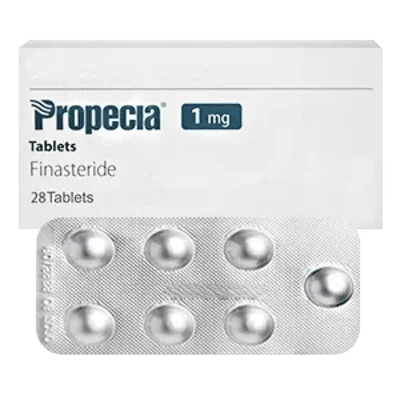
Propecia is a prescription finasteride tablet for adult men with male pattern hair loss. It is used for androgenetic alopecia affecting the crown and mid-scalp. By lowering scalp DHT, it helps slow follicle miniaturization and support hair preservation.
Propecia contains finasteride, a prescription 5-alpha-reductase type II inhibitor formulated to treat male pattern hair loss by lowering scalp DHT levels. It is intended for adult men with androgenetic alopecia at the crown and mid-scalp. Taken daily, the tablet works to halt follicle miniaturization and support regrowth over several months of continuous use.
Propecia belongs to a drug class called 5-alpha-reductase inhibitors. Each tablet delivers finasteride, the compound responsible for its effect on hair follicles. The dose is stated on the pack — follow the leaflet. The hair-loss dose is distinct from finasteride tablets used for benign prostatic conditions — the two are not interchangeable, and a higher dose does not mean a better result for hair loss.
The dose is stated on the pack — follow the leaflet. Swallow it whole with water.
| Parameter | Detail |
|---|---|
| Dosage | The dose is stated on the pack — follow the leaflet |
| Frequency | Once daily, same time each day |
| Administration | Oral, with or without food |
A few practical points worth knowing before starting:
Finasteride blocks the type II isoenzyme that converts testosterone into dihydrotestosterone (DHT) [1]. DHT is the hormone primarily responsible for shrinking genetically susceptible hair follicles on the scalp. By cutting scalp DHT production, finasteride slows and often stops the progressive thinning that defines male androgenetic alopecia.
Hair follicles affected by DHT go through a process called miniaturization. Each growth cycle produces a thinner, shorter hair until the follicle stops producing visible hair at all. Lowering DHT interrupts this cycle. The follicle isn't destroyed — it's suppressed. That distinction matters, because it explains why finasteride can only protect follicles that are still active, not regenerate ones that have gone fully dormant for years.
It is intended for adult men with androgenetic alopecia at the crown and mid-scalp.
The FDA approved this 1 mg indication for adult men with male pattern hair loss. Sudden or patchy hair loss requires a separate clinical evaluation.
Propecia is an oral, single-ingredient prescription treatment that works by suppressing scalp DHT. This differs from topical approaches, which are applied to the scalp, and from combination products that use more than one active ingredient or mechanism.
Finasteride's most discussed side effects involve sexual function, and the data on this is specific rather than vague. In the pivotal trials supporting its hair-loss indication, decreased libido occurred in roughly 1.8% of men on finasteride versus 1.3% on placebo, and erectile dysfunction was reported in about 1.3% versus 0.7% . Most men who experienced these effects saw them resolve while continuing treatment; a smaller subset reported symptoms persisting after stopping, which is why some clinicians now ask about baseline sexual function before starting.
Mood-related effects are rarer but documented. Some men report low mood or increased anxiety after starting finasteride, prompting regulatory bodies including the EMA to update product information with warnings about depressive symptoms [3].
There's a practical lab interaction worth flagging: finasteride lowers prostate-specific antigen (PSA) levels by roughly half, even in men with no prostate pathology. Anyone on finasteride who undergoes PSA screening should tell the ordering physician, since the result needs doubling to approximate the untreated baseline — otherwise an early prostate issue could be missed.
Less common reactions include breast tenderness or enlargement, and rare hypersensitivity reactions such as rash or lip swelling. Most men tolerate the tablet without any of these effects at all — the trade-off is real, but it affects a minority of users.
In clinical practice, physicians tend to frame finasteride as a maintenance therapy rather than a quick fix. The honest conversation at the prescribing stage usually centers on patience: most of the visible benefit shows up after month six, not month one. Doctors monitoring patients long-term typically ask about mood and sexual function at follow-up visits, not because problems are expected in most men, but because early detection makes management easier if they do occur.
Clinicians also tend to flag the PSA interaction proactively, especially for men over 50 who are due for prostate screening, since an unadjusted PSA reading taken while on finasteride can understate risk.
Clinical data reviewed by the FDA and referenced in EMA product documentation shows measurable hair count improvements typically appearing around month six, with continued gains tracked through 12 months in long-term trials conducted through 2025 . Earlier than that, the main effect is a slowdown in shedding rather than new growth. Results vary by individual and by the extent of hair loss before starting.
Most men who experience decreased libido or erectile dysfunction on finasteride find these effects resolve either during continued treatment or shortly after stopping. A smaller group of men have reported persistent symptoms after discontinuation, which is why the EMA updated safety labeling to include post-treatment sexual dysfunction as a recognized, uncommon risk . The EMA product information available in 2024 describes these sexual adverse reactions and advises clinical review. Anyone experiencing new sexual symptoms should discuss them with a prescriber rather than assuming they're unrelated.
Clinical trial data shows finasteride's strongest evidence base is for vertex (crown) and mid-scalp thinning, with somewhat more variable response at the frontal hairline . Men with primarily frontal recession may see a more modest response than those with crown-pattern loss. The FDA Propecia label from 2024 reports study data mainly for vertex and anterior mid-scalp hair loss. This doesn't mean no effect — it means expectations should be calibrated to the pattern involved.
Yes. Finasteride reduces PSA levels by approximately 50% in most men, an effect documented in prescribing information reviewed by MOHAP and supported by broader WHO-referenced pharmacology data on 5-alpha-reductase inhibitors [4]. Anyone scheduled for a prostate screening should inform the ordering clinician that they take finasteride so the result can be interpreted correctly. The FDA label available in 2024 instructs clinicians to account for finasteride-related reductions in PSA values.
Finasteride can be absorbed through the skin, and exposure during pregnancy carries a risk of abnormal genital development in a male fetus. Intact, coated tablets pose minimal handling risk, but crushed or broken tablets should never be handled by a woman who is or may become pregnant. If accidental exposure occurs, washing the area thoroughly and contacting a healthcare provider is the appropriate next step. The FDA Propecia labeling available in 2024 gives the same warning about handling crushed or broken tablets during pregnancy.
Restarting after a gap is generally safe from a tolerability standpoint, but any hair density gained during the first course is typically lost during the time off, since the protective DHT effect only lasts while the drug is active in the system. Restarting resets the clock on the 3-to-12-month timeline rather than picking up where treatment left off. Continuous daily use is how the drug's hair-loss indication was studied and is intended to be used. The FDA prescribing information available in 2024 describes continuous daily dosing, so any restart after a gap should be discussed with a prescriber.
Your order will be securely packed and shipped within 24 hours. This is exactly what your package will look like (images of an actual item sent). It has the size and look of a regular private letter (24x11x0.7 cm) and its contents cannot be seen.

Store the tablets at room temperature, generally below 30°C, away from direct sunlight and moisture. Keep them in the original blister pack until the moment of use — this protects both the tablet's stability and anyone handling it from incidental skin contact with the active substance. Keep the box out of reach of children and away from humid environments like bathroom cabinets.
Shedding in the shower noticeably dropped by month three. Density improvement took longer, maybe month seven before my barber commented on it. No sexual side effects for me, but I know it's not the same for everyone.
Had some dip in libido around week six. Talked to my doctor, we agreed to keep going another two months before deciding anything, and it actually improved on its own by month three.
Hairline didn't really change but the crown filled in a bit, which was my main concern anyway. Takes real commitment to stay consistent for over a year before judging it.
Mild breast tenderness in month two that went away after a few weeks. Otherwise straightforward — one tablet with breakfast, easy to keep up.